NewCaptions in Recording Studio: every word lights up as you say it, spelled from your script.

Free templates

Podcast script templates. Copy one, fill it in, read it aloud.

4 free templates with filled-in examples, from a class podcast to an interview. Each is formatted for a teleprompter, with sections to jump between and reminders where to pause.

Class podcast episode script template

Students explaining a topic, a book or a project in a short episode

# Intro

Welcome to {show name}, the podcast where {who you are} explain {what the show covers}. I'm {your name}. smile Today's question is: {the question this episode answers}? pause

# Why it matters

You might think {what most people assume}. But {what's actually true, or why it's interesting}. breathe

# Three things to know

First, {point one}. pause Second, {point two}. pause Finally, {point three}.

# Wrap-up

So, {the question}? The short answer is {your one-sentence answer}. Thanks for listening to {show name}. Next time, we'll look at {next topic}.

See a filled-in example

# Intro

Welcome to Science in Six, the podcast where the students of room 12 explain one big idea in six minutes. I'm Priya. smile Today's question is: why is the sky blue? pause

# Why it matters

You might think the sky is blue because it reflects the ocean. But it's actually the other way round. The sky gets its color from sunlight, and the ocean partly reflects the sky. breathe

# Three things to know

First, sunlight looks white, but it's made of every color mixed together. pause Second, when sunlight hits the air, blue light gets scattered around much more than red light. pause Finally, all that scattered blue light reaches our eyes from every direction, so the whole sky looks blue.

# Wrap-up

So, why is the sky blue? The short answer is that air scatters blue light more than any other color. Thanks for listening to Science in Six. Next time, we'll find out why sunsets are red.

Example length
About 145 words
Scripted part takes
58 sec

Tip: Open with the question your episode answers. Listeners can't see your slides, so say where you are: first, second, finally.
Interview episode script template

Talking to a guest, from a classmate or teacher to an expert

# Intro

This is {show name}, and I'm {your name}. smile My guest today is {guest's name}, who {one line about who they are}. We're talking about {the topic}. {Guest's first name}, welcome to the show. pause

# Questions

How did you first get into {their field or topic}? long pause What's something about {the topic} that most people get wrong? long pause Can you tell us about a time when {a specific moment worth hearing about}? long pause What would you tell {your listeners} who want to {a goal they share}? long pause

# Outro

{Guest's first name}, thank you so much for joining us. smile If you want to hear more from {guest's first name}, {where to find them}. That's all for this episode of {show name}. See you next time.

See a filled-in example

# Intro

This is Hallway Voices, and I'm Daniel. smile My guest today is Ms. Ortiz, who has coached our school's robotics team for eight years. We're talking about what it takes to build a robot in six weeks. Ms. Ortiz, welcome to the show. pause

# Questions

How did you first get into robotics? long pause What's something about robotics competitions that most people get wrong? long pause Can you tell us about a time when the robot broke right before a match? long pause What would you tell students who want to join the team but have never built anything? long pause

# Outro

Ms. Ortiz, thank you so much for joining us. smile If you want to see the team in action, the regional competition is in the gym next month. That's all for this episode of Hallway Voices. See you next time.

Example length
About 129 words
Scripted part takes
52 sec

Tip: Script the intro, the questions and the outro, and leave the answers unscripted. A good follow-up beats a perfect list.

Solo episode script template

One host, one idea, for creators and teachers recording a regular show

# Cold open

{A short story, question or surprising fact that hooks the listener.} pause

# Intro

Welcome to {show name}. I'm {your name}, and this is the show about {what the show covers}. smile In this episode, {what the listener will get from it}. breathe

# The main idea

Here's what I've learned about {the topic}: {your main point}. Let me give you an example. {A specific example or story.} pause And here's why that matters for you: {how it applies to the listener}.

# Takeaway

If you remember one thing from today, make it this: {your one takeaway}. pause

# Outro

Thanks for listening. If this was useful, {the one thing you'd like them to do}. I'll be back {when the next episode comes out} with {what's next}.

See a filled-in example

# Cold open

Last month, I graded ninety essays in one weekend, and I didn't take a single one home. pause

# Intro

Welcome to Teach Lighter. I'm Mr. Chen, and this is the show about doing great teaching with less burnout. smile In this episode, you'll get the feedback routine that gave me my weekends back. breathe

# The main idea

Here's what I've learned about grading: students read your first comment and skip the rest. Let me give you an example. When I stopped writing ten notes per essay and wrote one clear next step instead, revisions got better, not worse. pause And here's why that matters for you: one comment takes a minute, and it's the one they'll actually use.

# Takeaway

If you remember one thing from today, make it this: one next step beats ten corrections. pause

# Outro

Thanks for listening. If this was useful, share it with a teacher friend who needs their weekend back. I'll be back next Tuesday with a five-minute lesson-planning trick.

Example length
About 154 words
Scripted part takes
1 min 2 sec

Tip: Write the way you talk to one person. A solo episode works best as a conversation with a single listener, not a speech to a crowd.

News roundup segment script template

School, club or community news in a short weekly roundup

# Open

It's {day and date}, and this is the {show name} news roundup. I'm {your name}. smile

# Top story

Our top story: {the biggest news, in one sentence}. pause {One or two details: what happens, when and where.}

# In other news

{Second story, in one or two sentences.} pause {Third story, in one or two sentences.} breathe

# Coming up

Coming up this week: {upcoming event}, on {day} at {time}. pause

# Close

That's the news for this week. {A sign-off line.}

See a filled-in example

# Open

It's Friday, the fourteenth of March, and this is the Eastside Echo news roundup. I'm Jordan. smile

# Top story

Our top story: the school library is reopening on Monday after its renovation. pause It has new study rooms, a recording booth for podcasts, and longer hours until five o'clock.

# In other news

The chess club won second place at the county tournament last weekend. pause And the cafeteria is adding a salad bar, starting next Wednesday. breathe

# Coming up

Coming up this week: the spring concert, on Thursday at six thirty in the auditorium. pause

# Close

That's the news for this week. Stay curious, and we'll see you next Friday.

Example length
About 97 words
Scripted part takes
39 sec

Tip: Lead with the story that affects the most listeners, and say every date and time slowly. Listeners can't scroll back.

How to write a podcast script

  1. Pick one question. Every episode answers one thing. If you can't say it in a sentence, the episode is trying to do too much.
  2. Hook first. Open with a story, a surprising fact or the question itself, before the welcome. Listeners decide quickly whether to stay.
  3. Signpost for the ear. Listeners can't see headings, so say them: first, second, finally. Repeat the main point at the end.
  4. Write the way you talk. Short sentences, everyday words, contractions. Read every line out loud and rewrite anything you stumble on.
  5. Script the edges, not the middle of an interview. Write the intro, the questions and the outro word for word, and let the guest's answers breathe.
  6. Time it. At about 150 words a minute, the speech length calculator tells you how long any script will run.

Reading it on the mic

Paste the finished script into our free online teleprompter, set it to your speaking pace and read with your head up. Marks like [pause] and [smile] show as small labels, so they remind you without being read out. On a Mac, Avocado reads the same format and, with Pro or one of its free weekly sessions, follows your voice, so the script waits when you go off it. There's more for hosts in teleprompter setups for podcasts.

For a class podcast

Have students write in pairs: one host, one guest, using the interview template, or a solo explainer with the class podcast template. Our free tools for teachers and students include practice scripts and a speech timer, all in the browser with no accounts.

Frequently asked questions

Read it on the mic. Avocado keeps the script in front of you.

Download Avocado

Free for Mac. No account, no card.

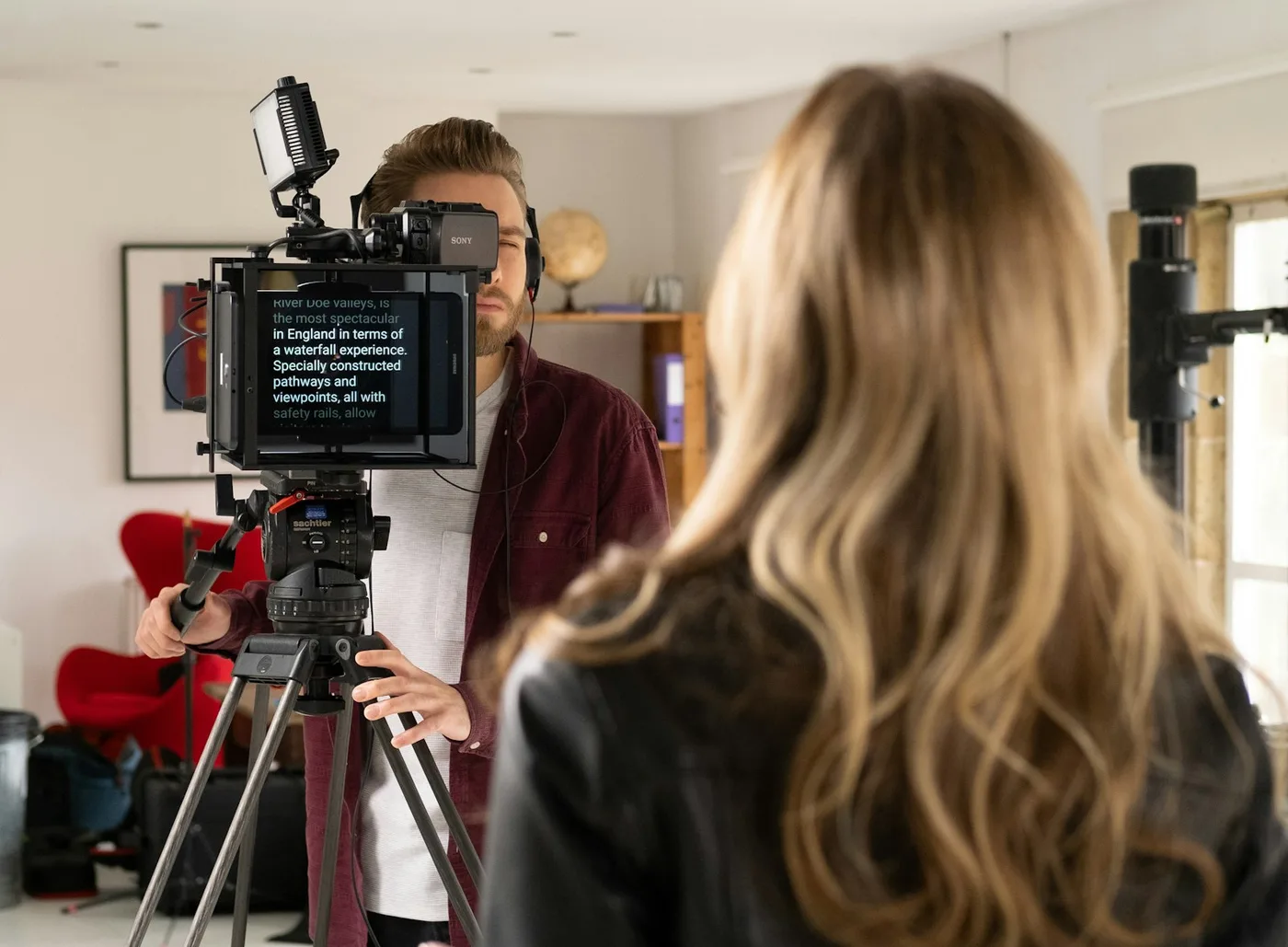
A woman reading from a teleprompter mounted on a camera while the operator films her