The Short Answer
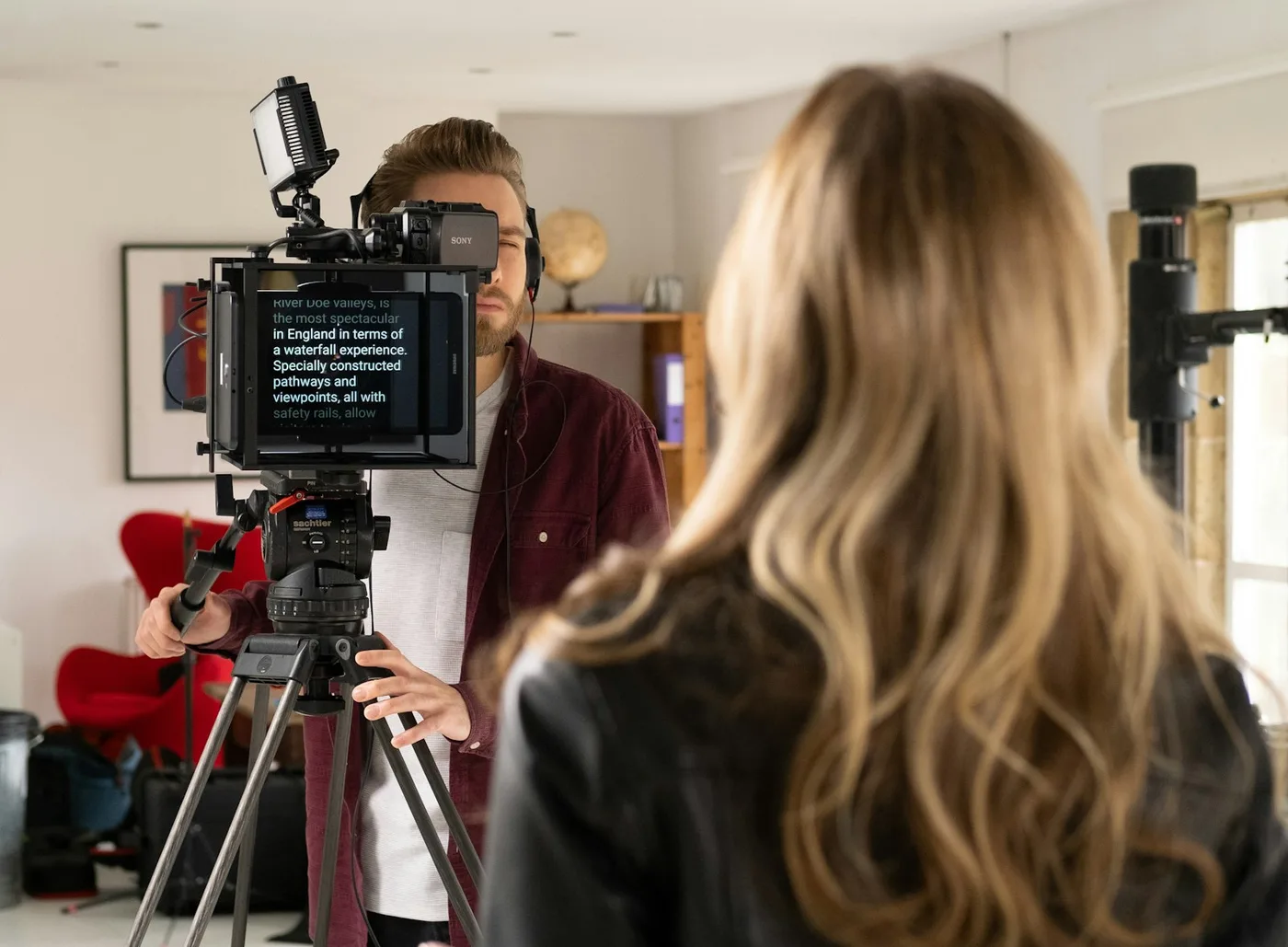
Teleprompter glass, also called beam-splitter glass, is glass with a partly reflective coating on one face. Held at 45° in front of a camera, it lets most of the light through to the lens while reflecting a screen lying beneath it towards you. The camera films straight through it, and you read the script off it while looking into the lens.
For most setups, buy 70/30 glass, 2 to 3 mm thick, sized so its long edge is at least 1.41 times the depth of your screen. Put the coated side towards you and the screen.
Why Not Ordinary Glass?
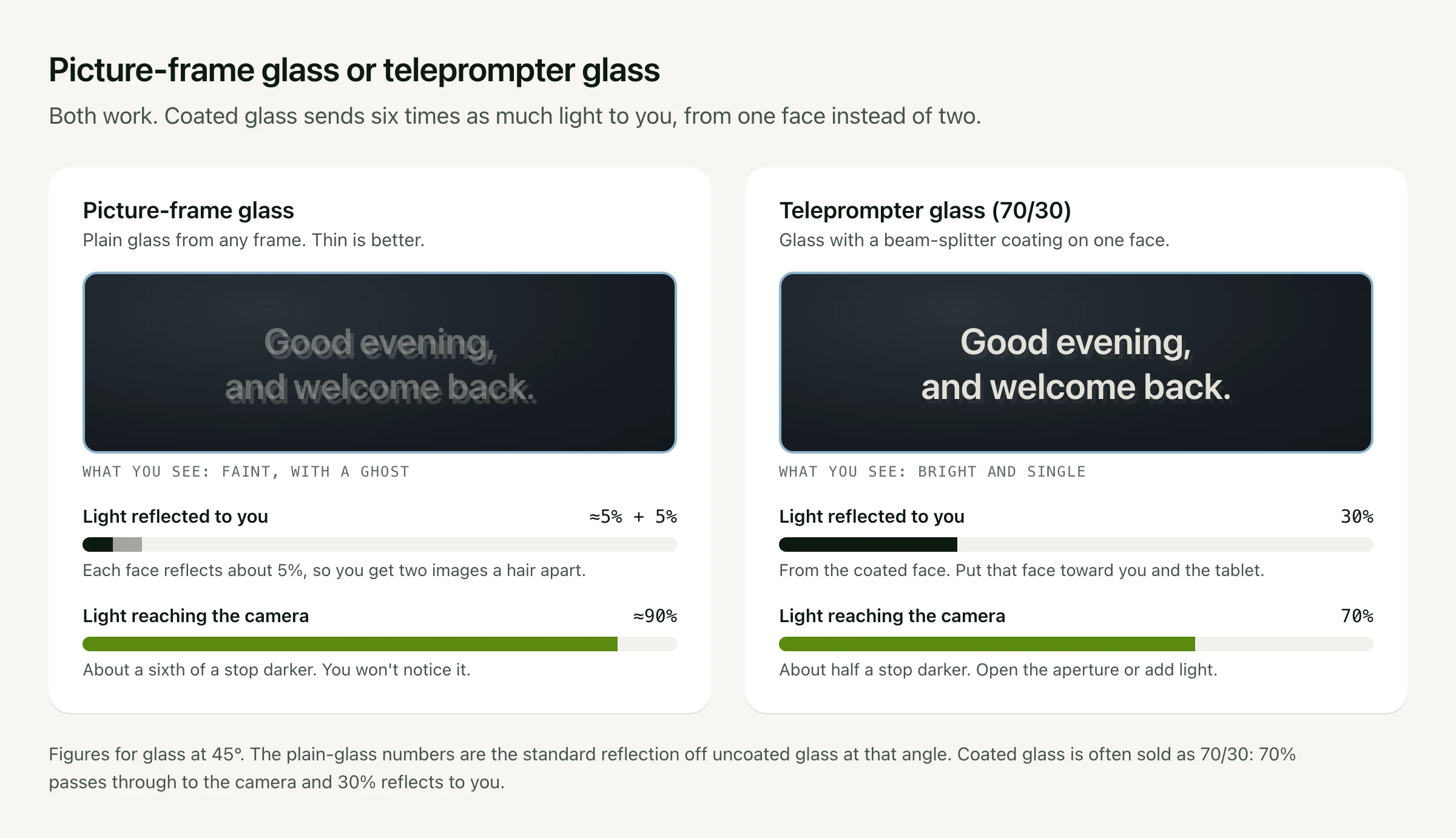
Ordinary glass works, which is why picture-frame glass is a popular first DIY teleprompter. But at 45° it reflects only about 5% of the light from each of its two faces. You get two faint copies of the script, a main image and a ghost just behind it, and you need a dim room and a bright screen to read it.
The coating on teleprompter glass reflects much more light, from one face only. With 70/30 glass, about 30% of the screen's light reaches you instead of about 5%, so the text is about six times brighter and the ghost is faint enough to ignore.
70/30 vs 60/40 vs 50/50
The two numbers are how the glass splits the light: the first is the share that passes through to the camera, the second the share reflected to you. More reflection makes the script brighter but lets less light reach the lens.
| Glass | Light to the camera | Light you lose | Script brightness |
|---|---|---|---|
| Plain glass | About 90% | Under ⅕ of a stop | Faint, with a ghost |
| 70/30 | 70% | About ½ a stop | Bright |
| 60/40 | 60% | About ¾ of a stop | Brighter |
| 50/50 | 50% | 1 stop | Brightest |
A stop is a halving of light, so the loss is worked out from the share that gets through: 70% is about half a stop, 50% a full one. Half a stop is easy to win back with a slightly wider aperture, a little more gain or one more light. That's why 70/30 is the usual choice: bright enough to read in a normally lit room, without much cost to the picture.
Go to 60/40 if you're reading in a bright space, such as near a window or under studio lights, or from further away. A 50/50 split is rarely needed for prompting.
Glass or Acrylic?
- Glass is flat and rigid and doesn't scratch easily, so it doesn't distort what the camera sees. It's heavier and it can break, which matters for a rig you travel with.
- Acrylic is lighter, cheaper and won't shatter. It scratches easily and can flex, and a sheet that bends even slightly warps the image the camera films through it.
For a rig that stays on a desk or in a studio, choose glass. For a light travel rig or a classroom where it might get knocked, acrylic is a fair trade, as long as it's held flat.
Which Side Faces You?
The coated side faces you and the screen below. If the coating faces the camera, the uncoated surface reflects first and you get a double image again.
To find the coated side, touch the tip of a pen to the glass and look at its reflection. On the coated side, the tip and its reflection meet. On the uncoated side, there's a gap between them the thickness of the glass. Many sheets also come with a protective film or a label on one side; check the seller's instructions before peeling it.
What Size Do You Need?
At 45°, the glass has to be about 1.41 times as long as your screen is deep, and at least as wide as the screen. Lay a tablet or phone sideways so the long edge carries the lines of text, and measure the short edge: that's the depth.
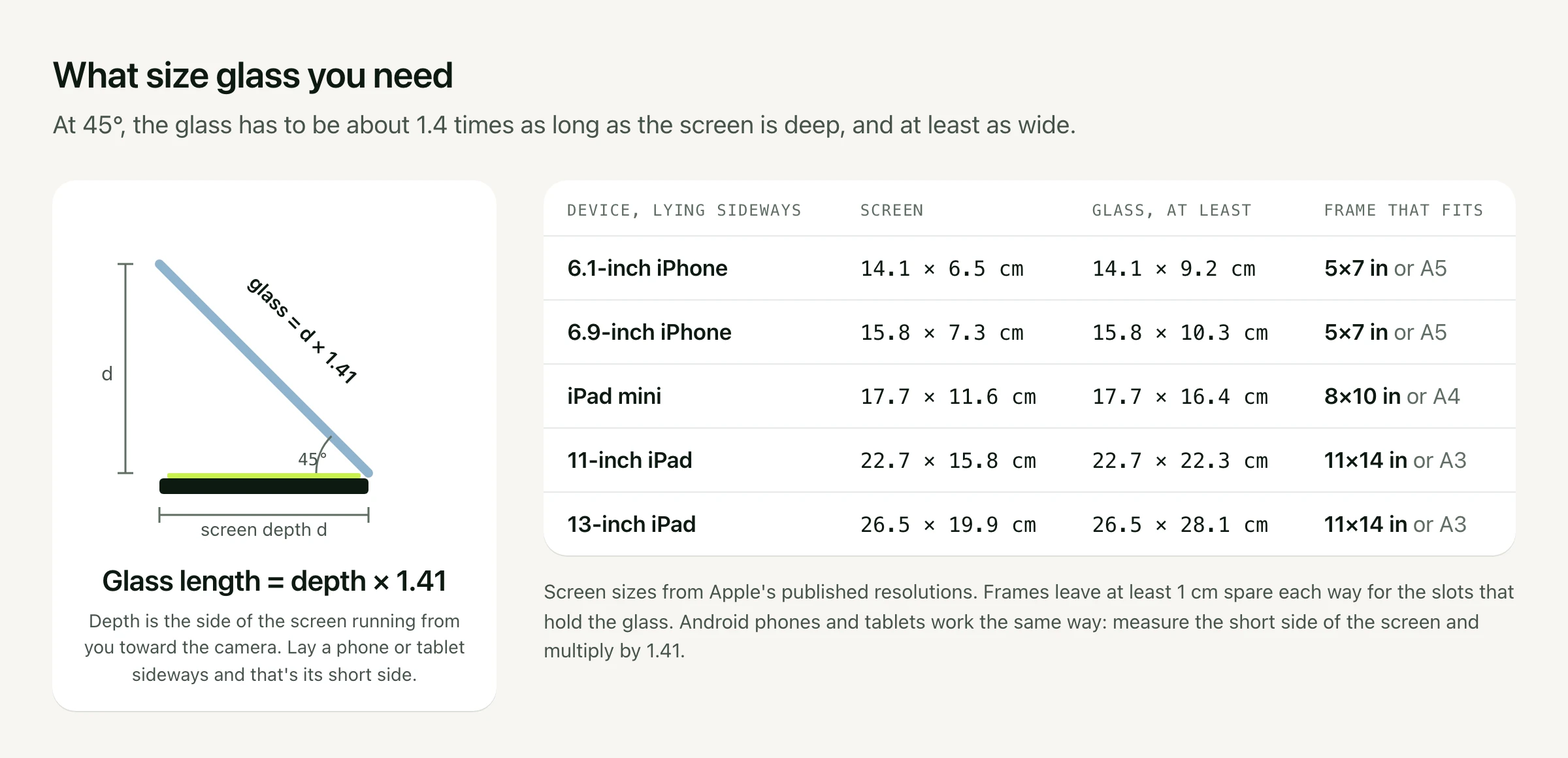
Allow a little extra on each side for whatever holds the glass. For a monitor rather than a tablet, measure its height in the same way.
Looking After It
- Clean it gently, with a microfibre cloth and lens cleaner, or a little water. Coatings can be damaged by harsh or ammonia-based glass cleaners, so check what the maker recommends.
- Hold it by the edges, and tape any bare edges on DIY glass, which can be sharp.
- Close off the back. A hood or black cloth between the glass and the camera stops reflections of the room and keeps the glass looking clear on camera.
Do You Need Glass at All?
Only if you film with a separate camera, such as a mirrorless camera, a camcorder or a phone on a tripod. Glass exists to put the words in front of a lens that has no screen beside it.
With a laptop's built-in webcam, text placed right under the camera is already close enough to read as eye contact. On a Mac, Avocado puts your script in the MacBook notch, about 2° below the lens, with no glass and no rig. When you do use glass, it can drive the screen under it: Avocado mirrors the text for glass, and its Viewer puts the script on a tablet under the glass from your Mac (Pro). Or open our free online teleprompter on the tablet and turn on Mirror text.