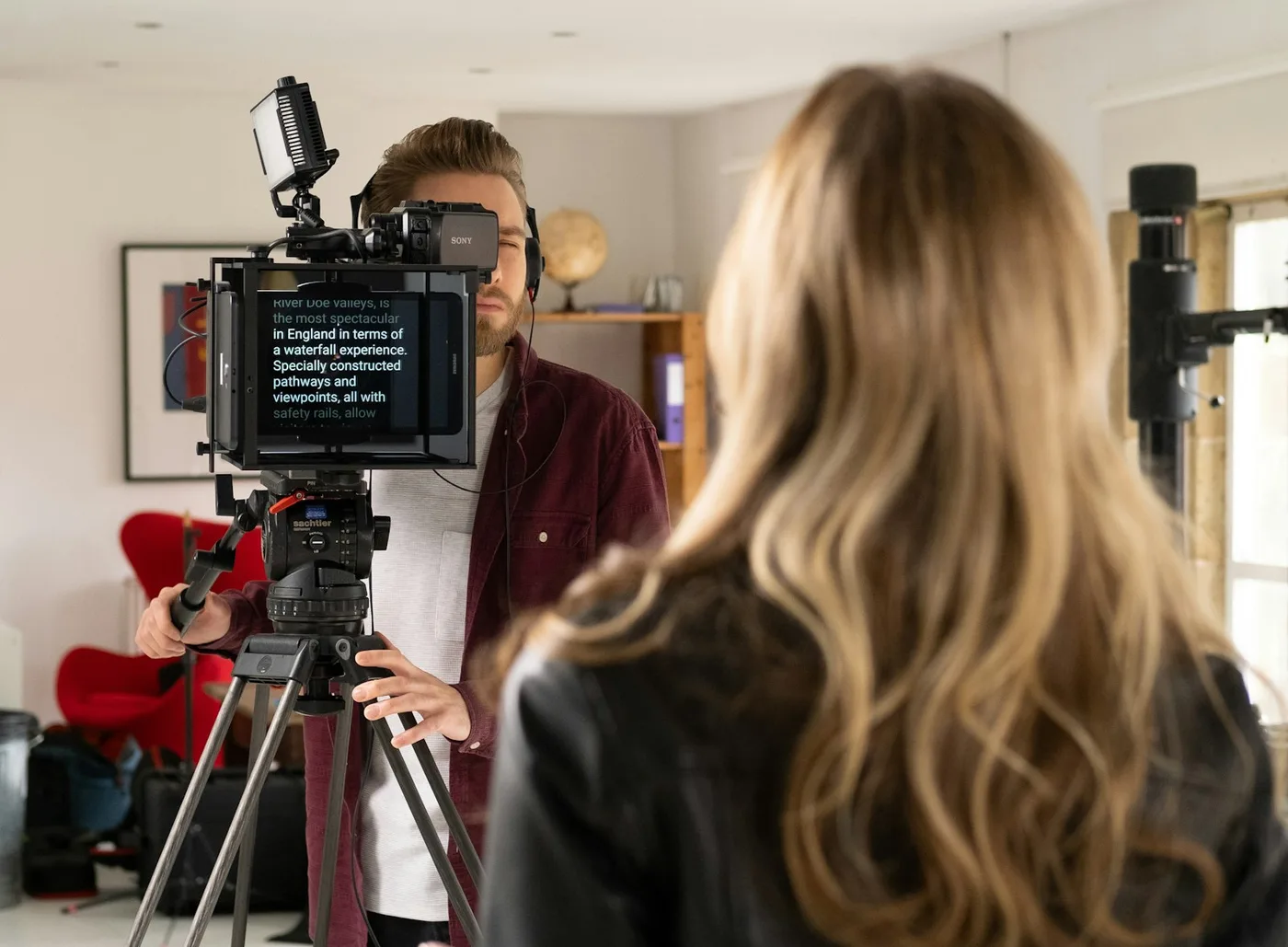
Repetition Is Not Rehearsal
Most people "rehearse" a talk by reading it start to finish a few times until it feels familiar. Familiarity feels like progress, so they stop. But run number eight is usually just run number one with more confidence baked into the same mistakes — the same rushed open, the same place you always lose your breath, the same three "um"s in the second paragraph. You're not improving the delivery. You're memorizing it, flaws included.
Deliberate practice — the kind that actually changes performance — needs three things repetition alone can't give you: a target to aim at, a measurement of where you landed, and a correction to apply on the next attempt. A teleprompter gives you the target: the words, at a pace you set. What's almost always missing is the measurement. You finish a run and you feel like it went better — but feelings are a famously unreliable narrator of your own delivery. Without a number, "better" is just a mood.
Avocado closes that loop. Every genuine run through the prompter is measured, scored, and remembered — so your next run has something concrete to beat.
The First Run Is Supposed to Be Rough
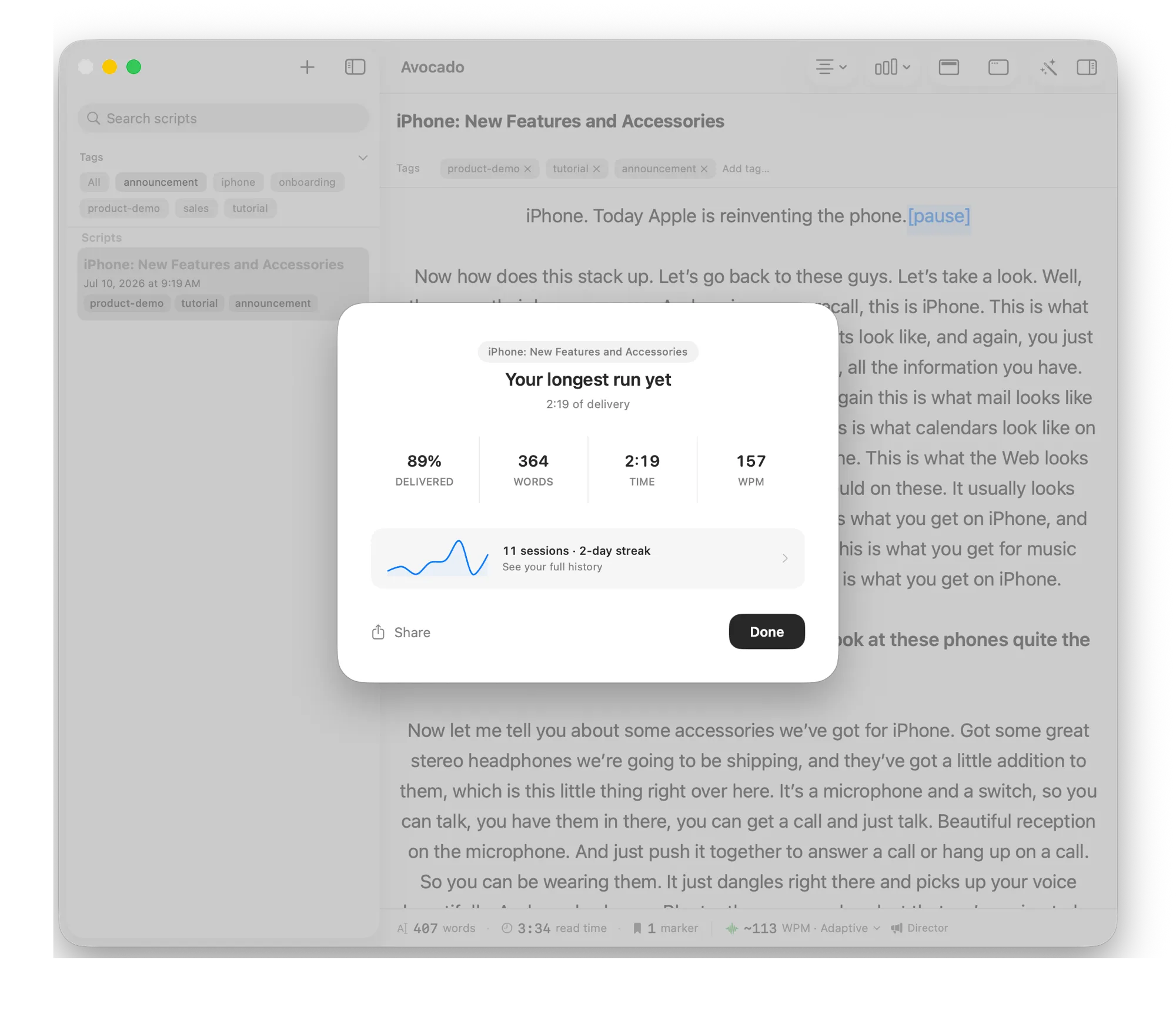
So you run it — out loud, on camera, against the scrolling text. You close the prompter and Avocado hands you a receipt: 64% delivered, three minutes, 176 words a minute. That last number stings a little. You thought you were composed; the tape says you were sprinting. And there's no arguing with it — the pace is just words delivered divided by time on stage, so it can't flatter you, and a four-second scrub to the end never counts as a real run.
But the header doesn't grade you against some ideal. It frames the run against your own past, and right now it simply reads Your first run. Nothing to beat yet. There will be.
The Second Run, You Know Exactly What to Fix
This is where a teleprompter usually leaves you on your own. You felt the wobble somewhere in the middle — but where, exactly? On macOS 26, Avocado listens to the same microphone your voice scrolling already uses and quietly counts the things you can't hear yourself do: the "um"s, the two-second silences where you lost your place, how steady your pace held from the first word to the last.
Your first run came back with nine fillers and four long pauses — and nearly all of them landed in one paragraph. The one you wrote last and never really learned. Suddenly it isn't "the whole talk" that needs another ten passes. It's forty words in the middle of it. So you rewrite those forty words, actually learn them, and run it again. That is the difference between practicing and rehearsing: you changed one specific thing on purpose.
The counting stays deliberately honest, by the way — an "actually" you wrote is your writing; an "actually" you blurt off-script is the crutch it flags. Nothing is invented, and if you're not sure what pace to aim for in the first place, the research on speaking speed is a good place to calibrate.
You Can See the Exact Moment It Clicks
Run over run, the receipts stack into a curve. Open the script's Rehearsal History and the shape of your progress is right there — pace settling, completion climbing toward the top, fillers thinning out — with the trend named for you: down 14 WPM since your first run. The early passes are jagged: fast, incomplete, stumbling in the same spot. The later ones flatten into a steady, near-complete delivery.
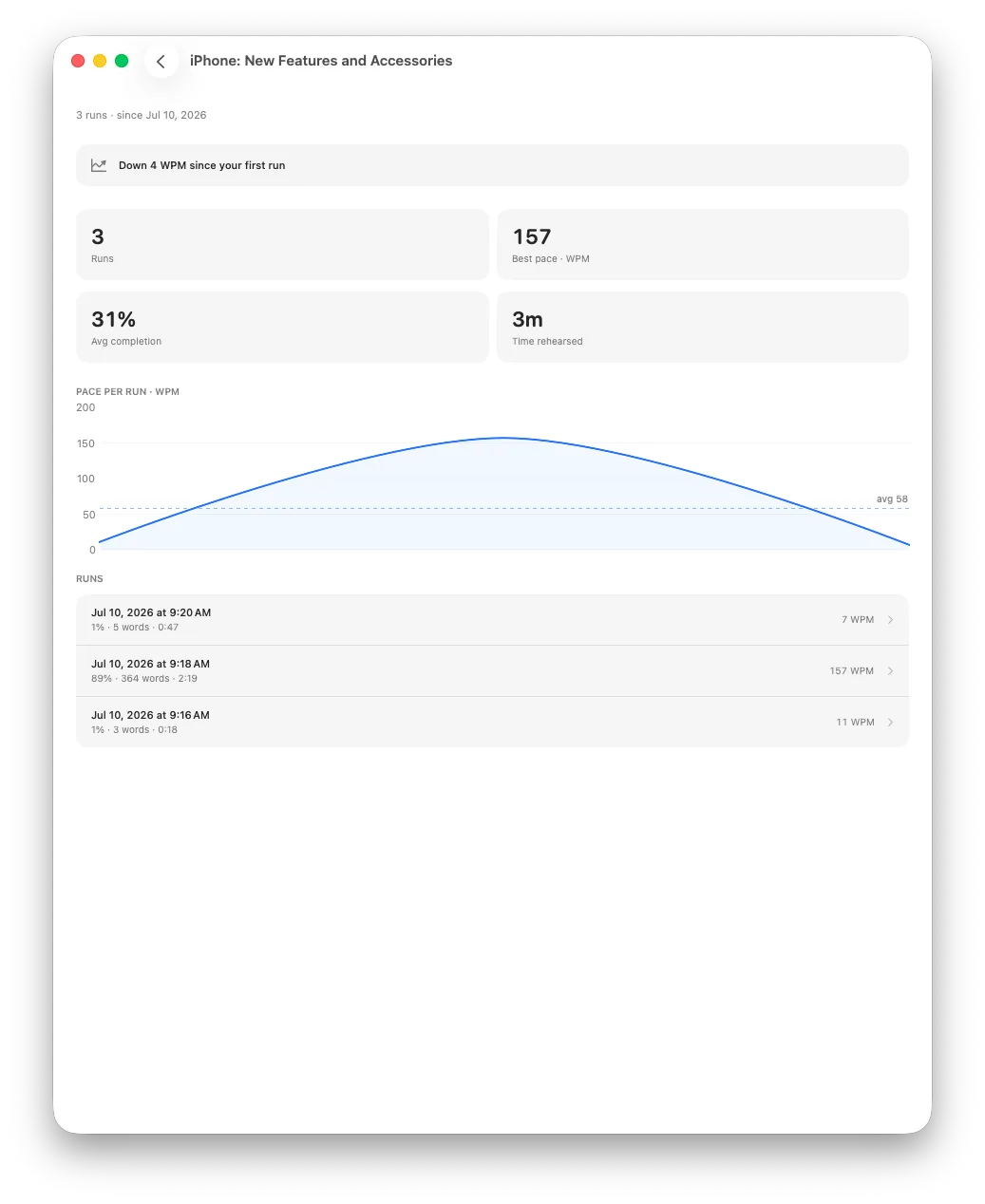
That flattening isn't a feeling that it went well. It's the measurement telling you you're ready — the one thing repetition alone could never give you.
Zoom out past a single script and all your runs roll into one history: time on stage, average pace, a day streak, and a short Coach's Note — written on-device — that names the single pattern worth working on next. The streak isn't a gimmick either: spacing rehearsal across a few days beats cramming it into one, and a visible streak is a cheap, effective nudge to come back tomorrow. And none of it leaves your Mac — the coaching runs locally, the words you actually spoke are never stored, only the counts. Your unreleased keynote, your audition sides, your earnings script: none of it touches a cloud.
Start the Loop
The receipt after every run and your last few sessions are free — enough to feel the loop working. Avocado Pro keeps the full history and the complete coaching breakdown so the curve never truncates, and every week the free plan includes three Pro Passes: redeem one and that whole session runs full-Pro, its report kept unlocked forever.
Reading your script until it feels familiar gets you a delivery you can survive. Rehearsing against real numbers — pace, fillers, pauses, run over run — gets you one you can trust. Start with the delivery fundamentals, then see Pro plans when you're ready to keep the whole history.